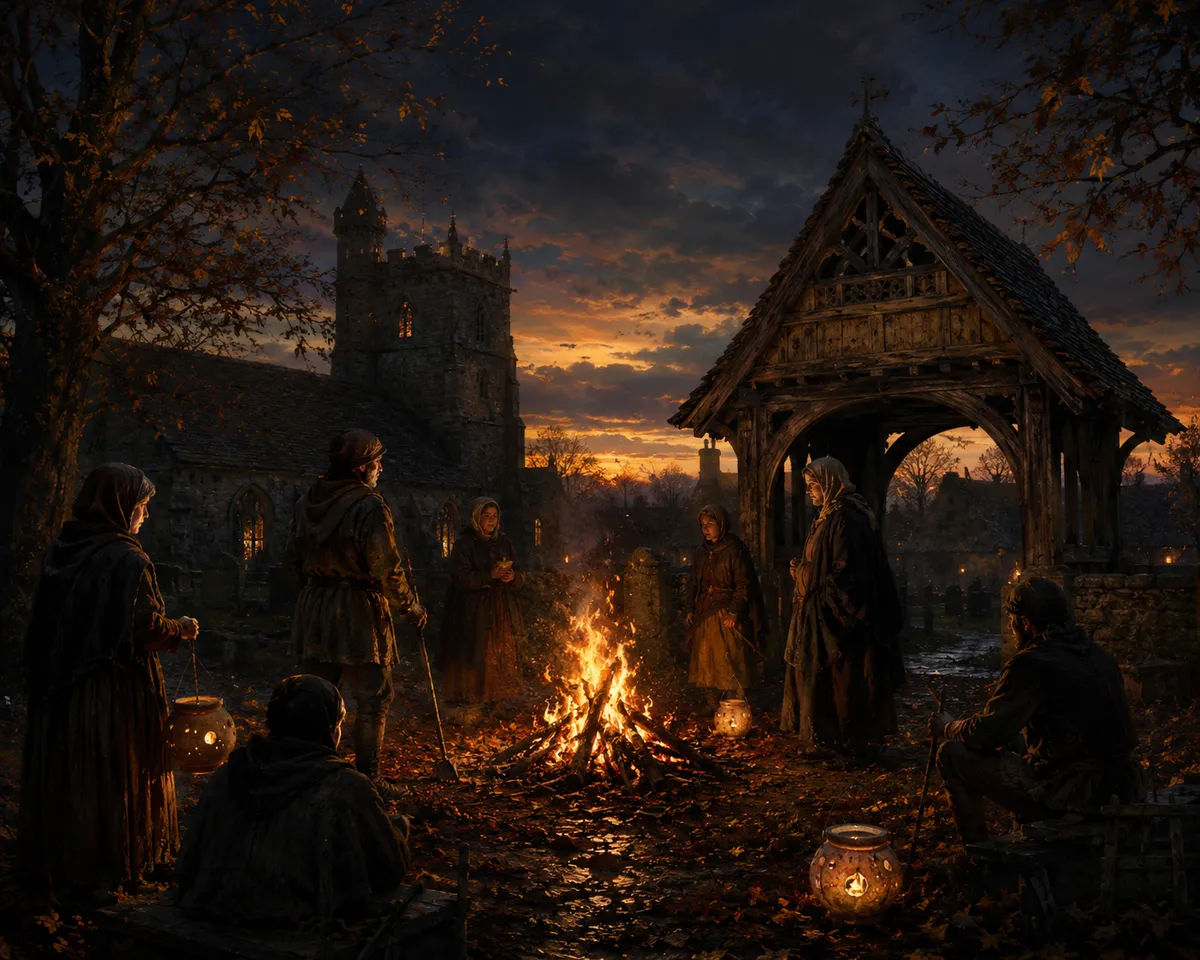
All Hallows: The Feast That Refused to Stay Still
On the first day of November, medieval England stopped. Fires were lit, ale was broached, and the dead were, depending on who you asked, somewhere rather closer than usual.
All Hallows — what we now call All Saints Day — was one of the biggest dates in the medieval calendar. But its roots are older than medieval England, older than the English church, and considerably older than anyone who was trying to organise it.
Where it came from
The church officially fixed All Saints as a November feast in 835, when Pope Gregory IV decided that all the saints — there were far too many to honour individually — deserved a collective day. Practical, tidy, done.
Except November wasn't an empty slot. Across the British Isles, something was already happening at that exact turning point in the year. The harvest was in, the livestock were coming back from the fields, winter was arriving, and there was a widespread belief that the boundary between the living and the dead was, for a few days, thinner than usual. The church didn't invent that idea. It arrived and found it already there, settled in, and entirely unwilling to leave.
What actually happened
In a real medieval English village, All Hallows was several things at once.
There was the official version — masses for the saints, prayers for the dead on All Souls Day on the second of November. That was the church's part of the arrangement.
Then there was everything else. On All Hallows Eve — the evening before — people lit fires, left food out, and moved through the dark with a wariness that centuries of church teaching had not entirely managed to shift. The saints were being honoured inside. Outside, other things were being attended to.
And underneath all of it, ale. Martinmas fell on the eleventh of November, just days later, and in rural communities the two feasts ran into each other comfortably. Martinmas was when new ale was traditionally opened for winter, when animals were slaughtered before the cold arrived, and when the farming year officially closed. The grain had been turned into ale before it could spoil. Someone had to drink it. This was considered a reasonable and correct response to the situation.
The church and everyone else
What makes All Hallows genuinely interesting is that it was never really one thing. The official church provided the structure. The village provided everything else.
A medieval villager's religious life was not a neat and tidy system.
It was old Roman church practice sitting on top of Anglo-Saxon tradition sitting on top of folk belief that had been there for generations before Christianity arrived — with whatever the local priest happened to have read that week adding further texture.
Saints were invoked when useful. Feast days were observed with varying levels of accuracy. Local customs that nobody could quite explain were kept going anyway because they had always been kept going.
All Hallows was where all of that was most visible — a feast that was simultaneously Christian, pre-Christian, agricultural, civic, and a perfectly good reason to open the ale. The church provided the occasion. The village provided the chaos.
How it became Halloween
The name Halloween is simply All Hallows Eve compressed over time — Hallows Even, Hallows E'en, Halloween. The folk traditions attached to the evening travelled with emigrants, particularly from Scotland and Ireland, into North America during the eighteenth and nineteenth centuries, where they grew into the holiday we recognise today. The carved lanterns, the costumes, the general sense that something is briefly loose in the world on the last night of October — all of it traces back to that medieval threshold moment. When the harvest was in, the fires were lit, and the dead were, for one evening, somewhat less reliably absent than usual.
Eight hundred years on, the harvest suppers are gone, the Martinmas ale is forgotten, and All Souls prayers are said by fewer people every year. But on the last night of October, without quite knowing why, people still light things, dress as the dead, and leave food out. Some habits are simply older than the reasons for them.