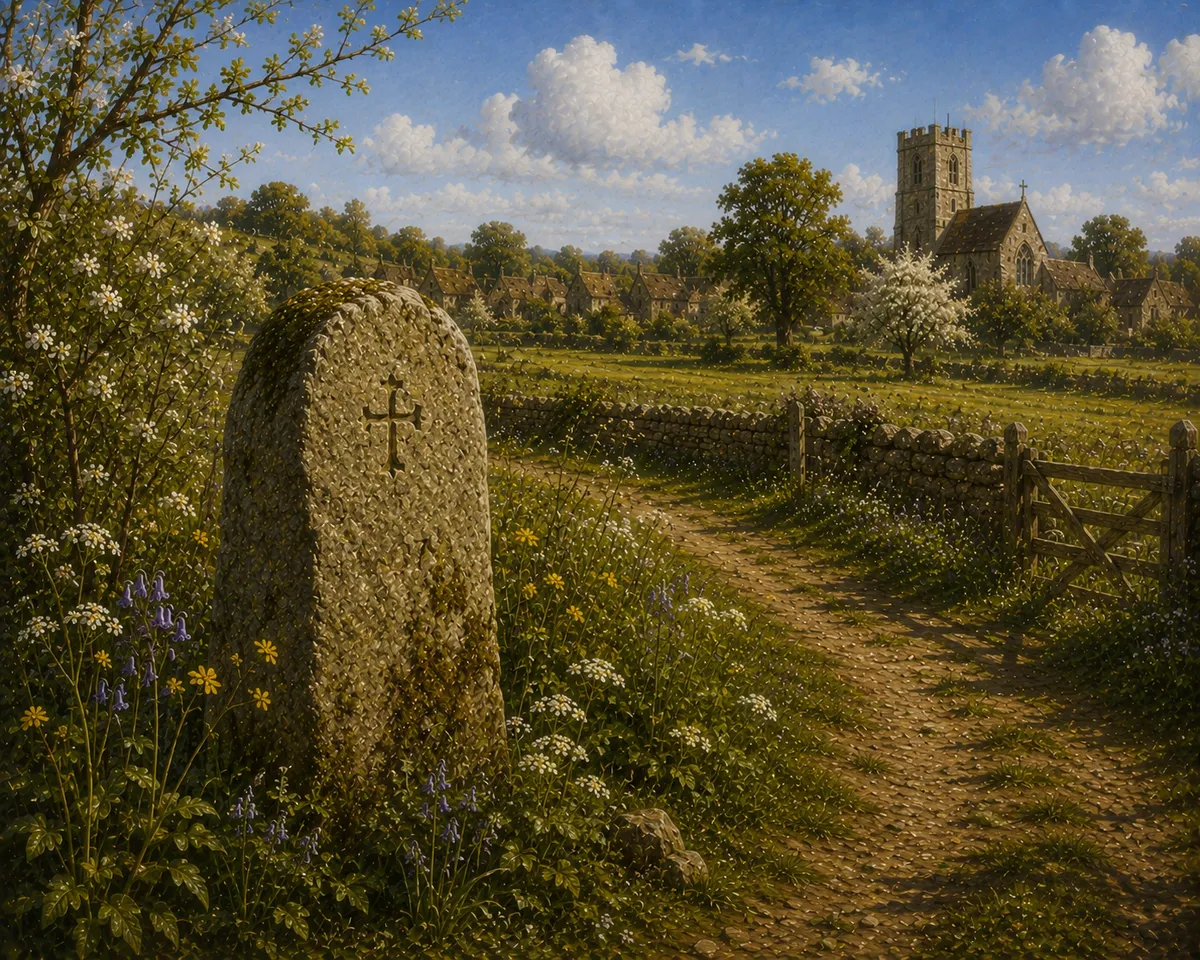
Beating the Bounds, (or how to make sure your land stayed yours in medieval England)
Before maps were common and literacy was rare, the boundary of a parish was not a line on paper. It was a walk.
Once a year, usually during Rogationtide — the fifth week after Easter — the people of a parish would leave their homes and walk the entire perimeter of their land. The rector led. The lord or his representative attended. The churchwarden came. And the children were brought along, whether they wanted to be or not.
This was not a pleasant spring outing.
Why it mattered
In medieval England, parish boundaries were serious legal and economic territory, and stones, trees, or other markers were how they were established and remembered.
These parish boundaries determined where your tithe was owed, which church you belonged to, whose jurisdiction you fell under, and who had the right to graze which land. A boundary that shifted — through a moved stone, a collapsed hedge, a conveniently forgotten corner — could cost a family their livelihood.
There were no official surveys. There were no maps.
The walk was the record.
The method
Participants carried willow wands and beat them against the boundary markers as they went — stones, trees, ditches, posts — partly as ceremony and partly, it seems, to make the moment feel significant enough to remember. The word beating almost certainly refers to this: striking the markers, not the children.
Almost certainly.
Because the children were also, so we are told, bumped, bounced, or pressed firmly against the boundary stones at key points. The intention was straightforward. A child who has had their head introduced to a stone at a particular location will remember that location. They will remember it for the rest of their life. When they are old and the rector is dead and the stone has sunk six inches into the ground, they will still know exactly where the boundary runs.
This was considered good practice.
Rogationtide
The timing was not accidental. Rogationtide was already a period of communal blessing — of fields, of crops, of the coming season. The church had absorbed an older tradition of walking the land and asking for its protection, and the boundary walk fitted neatly inside it. You were not simply marking your territory. You were, in theory, placing it under God's supervision for another year.
What happened to it?
Beating the Bounds did not disappear when maps arrived. It retreated, slowly, into ceremony. Some parishes kept it going out of habit. Some revived it out of affection for the tradition. A number of Oxford colleges still beat their bounds today, navigating streets and buildings that have long since covered whatever field boundary originally mattered.
In those cases the willow wands are still carried.