Did You Know: Medieval Villages Had to Police Themselves?
Before police forces, CCTV, or anyone with official authority beyond shouting louder than everyone else, medieval English villages had to keep order themselves. And the system they used was, by any modern measure, completely chaotic.
The Tithing — Your Compulsory Neighbourhood Watch
Every male aged twelve and over was assigned to a group of roughly ten neighbouring households called a tithing. You didn't choose your group — you were placed in it based on where you lived, and you stayed in it.
The groups were organised by the lord of the manor and checked twice a year at an official inspection called the View of Frankpledge, to make sure everyone was properly enrolled. No sneaking out of your tithing. No switching groups because you didn't like your neighbours.
Here's where it gets interesting. Every tithing was collectively responsible for the behaviour of its members. If one man committed a crime and couldn't be brought to court, the entire group was fined. Not because they did anything wrong — just because he was one of theirs and they failed to produce him.
The logic was simple: if your neighbours know they will be punished for your crimes, they will keep a very close eye on you.
Women, the clergy, and the very wealthy were exempt. Everyone else — every farmer, baker, innkeeper and twelve year old boy in the village — was in a tithing, quietly hoping their neighbours behaved themselves.
You weren't asked if you wanted to join. You were in it. Good luck with your neighbours.
Hue and Cry — The Original Emergency Alert
If you witnessed a crime, you were legally required to shout. Loudly. And chase the criminal. Everyone who heard you was also legally required to join the chase, regardless of what they were doing at the time.
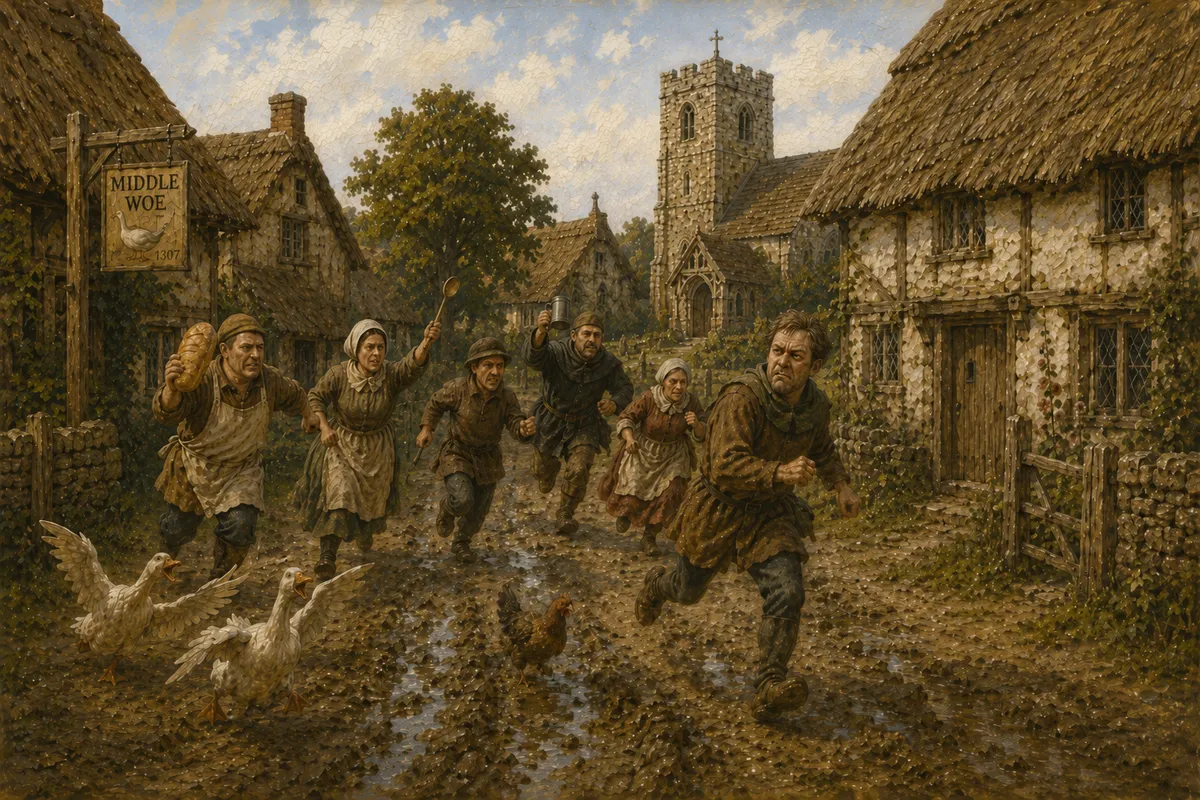
Failure to join in could result in a fine. So if you heard shouting and decided it wasn't your problem, it very quickly became your problem.
The Parish Constable — Nobody's Favourite Job
From 1285, parishes were required to appoint a constable to help keep the peace. This was an unpaid role, held for one year, and performed alongside your actual job.
Men were effectively voluntold into the role. There was no training, no uniform, and no pay. Just a year of everyone in the village making your life difficult while you tried to stop them.
The Posse — When Everything Else Failed
If the Hue and Cry didn't work and the criminal was still at large, the sheriff could form a posse — a group of men conscripted to help with the search. Again, compulsory. Again, unpaid.
In Summary
Medieval law enforcement was essentially a series of systems that made the entire village responsible for everything, all the time, whether they liked it or not.
It was communal, chaotic, and deeply inconvenient for everyone involved.