Who Actually Ran a Medieval Village?
(Or: Why Everything Somehow Involved Sheep)
When we imagine a medieval village, we often picture peasants, a church, and a distant lord. But day-to-day life was run by a surprisingly busy chain of authority, paperwork, and petty enforcement — especially in the early 14th century — at least in theory.
The Lord of the Manor
The Lord of the Manor technically owned the land — or at least claimed legal rights over it. Most villagers didn’t own their fields outright; instead, they held strips of land in return for rent, labour, or other obligations.
In a medieval village, the lord was the legal and economic authority, not the person running daily life.
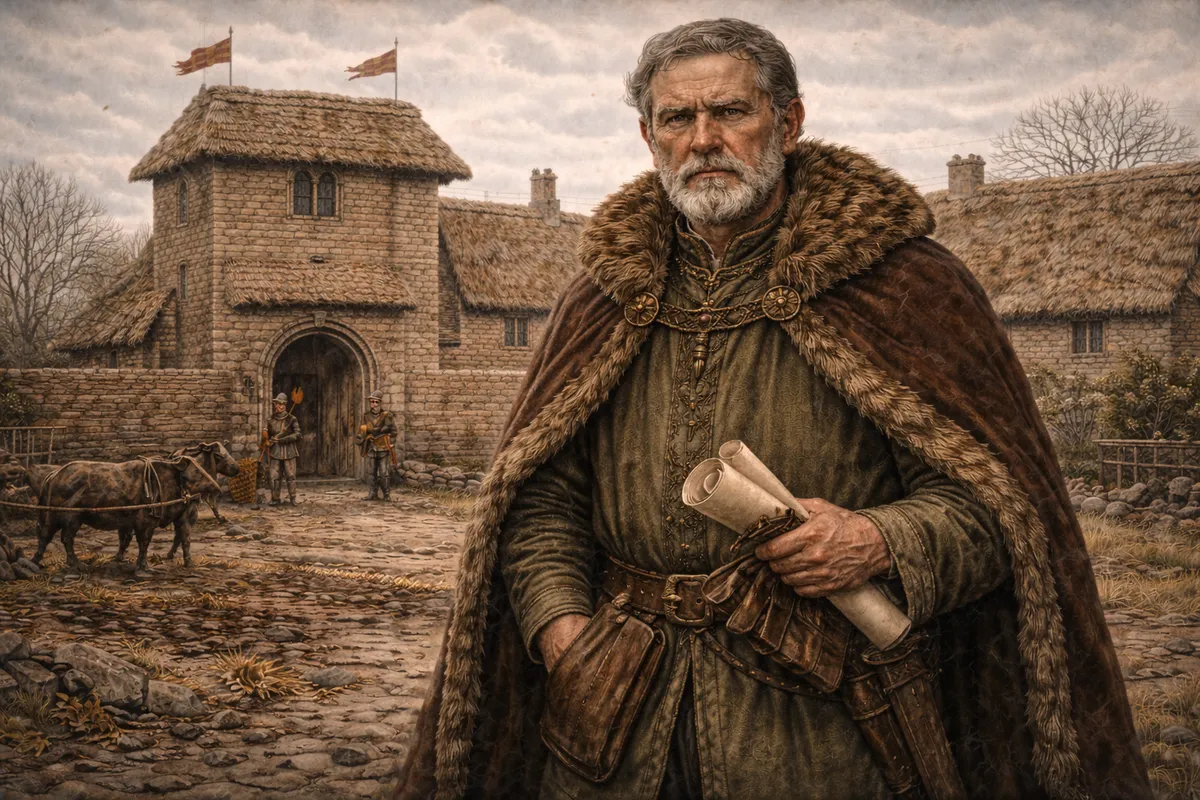
He owned the manor and its land, and villagers held their plots in return for rent, labour, or services. He collected income through rents, fines, and fees for using things like the mill or oven.
The lord also held the manorial court, which dealt with land matters, local rules, and minor disputes. This wasn’t justice as we’d understand it today — it was about keeping order and ensuring income.
In practice, the lord rarely managed village life directly. That work was done by local officials acting in his name. The lord set the framework; villagers lived with the consequences.
In many cases, the lord did not live in the village at all.
The Steward
The steward ran the manor on the lord’s behalf.
When the lord was not present — which was often — the steward held effective control over the village.
He managed finances, oversaw rents and records, organised manor courts, and interpreted “custom” with great confidence.
The steward was usually educated, literate, and keen on documentation.
This is bureaucratic boss energy: the person who insists the rules are ancient, binding, and definitely written down somewhere. You can imagine what they were like.
The Bailiff
The bailiff handled day-to-day enforcement.
He collected rents and fines, organised labour services, enforced manor rules, and made sure people turned up where required. Villagers were often afraid of the bailiff: his job was to make sure they did theirs.
Bailiffs were frequently unpopular, but powerful in practice.
“I don’t make the rules. I just enforce them.” (He absolutely enjoyed enforcing them.)
The Reeve
The reeve was responsible for the general management of the village.
He was chosen from among the villagers themselves, usually reluctantly, and blamed for almost everything.
The reeve was not an outside official, but a neighbour — often selected for a fixed term, and often against his better judgement.
He was very much on the ground, responsible for ensuring that villagers completed their labour services on the lord’s land.
This made him both essential and deeply unpopular.
The Constable
The constable was responsible for maintaining peace within the village.
He was not a modern police officer, but a practical figure whose role included:
- breaking up disputes
- escorting offenders
- keeping order during gatherings and courts
When matters escalated, the constable was expected to step in — ideally before things worsened.
Villeins, Serfs, and Other Tenants
Most people in a medieval village were tenants, meaning they held land from the lord rather than owning it outright.
Most villagers were villeins — people who worked the land but did not own it outright.
They held land in return for rent and labour, usually working the lord’s fields for part of the week. They were not slaves, but they were not free to leave the manor without permission.
Serfs were more tightly bound to the land. Their obligations were heavier, and their freedom more limited. If the land changed hands, they usually did too.
Alongside them were freer tenants, who paid rent mostly in money and had greater control over their lives. Some could move away, trade, or accumulate property, depending on local custom.
What mattered most was not the label, but the obligations attached to the land. Life in a medieval village was defined less by status than by what you owed, to whom, and when.
In daily life, these distinctions mattered greatly in records and courts — and rather less when work needed doing.
In Summary
A system of layers
A medieval village was governed not by simplicity, but by layers.
Authority flowed downward: lord → steward → bailiff → reeve → villagers
Responsibility flowed upward: villagers → reeve → bailiff → steward → lord
And confusion moved freely in all directions.
In theory, the system created order. In practice, it created paperwork, disputes, and an astonishing amount of regulation concerning sheep.